
Abhinav Bindra: Gold

Sushil Kumar:

Vijender:


By 2010, the Olympic Games will have been hosted by 41 cities in 22 countries. The upcoming 2008 Summer Olympics will be held in Beijing, and the 2010 Winter Olympics will be held in Vancouver. The number in parentheses following the city/country denotes how many times that city/country had then hosted the games, with said exclusions.
This table does not include the "Olympic Games" organized by Evangelos Zappas prior to the IOC's creation in 1894. It does list the "Intercalated Games" of 1906, but it is not included in the counts as the IOC no longer considers them to be official Olympic Games.
| Summer Olympic Games | Winter Olympic Games | ||||||
|---|---|---|---|---|---|---|---|
| Year | № | Host city | Country | № | Host city | Country | |
| 1896 | I | Athens (1) |  Greece (1) Greece (1) | ||||
| 1900 | II | Paris (1) |  France (1) France (1) | ||||
| 1904 | III | St. Louis, Missouri(1) (1) |  United States (1) United States (1) | ||||
| 1906 | Int'd | Athens (not recognized) | Greece | ||||
| 1908 | IV | London (1) |  United Kingdom (1) United Kingdom (1) | ||||
| 1912 | V | Stockholm (1) |  Sweden (1) Sweden (1) | ||||
| 1916 | VI (2) | Berlin |  Germany Germany | ||||
| 1920 | VII | Antwerp (1) |  Belgium (1) Belgium (1) | ||||
| 1924 | VIII | Paris (2) | France (2) | I | Chamonix (1) | France (1) | |
| 1928 | IX | Amsterdam (1) |  Netherlands (1) Netherlands (1) | II | St Moritz (1) |  Switzerland (1) Switzerland (1) | |
| 1932 | X | Los Angeles, California(1) |  United States (2) United States (2) | III | Lake Placid, New York (1) | United States (1) | |
| 1936 | XI | Berlin (1) |  Germany (1) Germany (1) | IV | Garmisch-Partenkirchen (1) | Germany (1) | |
| 1940 | XII (3) | Tokyo→ Helsinki |  Japan→ Japan→ Finland Finland | V (3) | Sapporo→ St Moritz→ Garmisch-Partenkirchen | Japan→ Switzerland→ Germany | |
| 1944 | XIII (3) | London | United Kingdom | V (3) | Cortina d'Ampezzo |  Italy Italy | |
| 1948 | XIV | London (2) | United Kingdom (2) | V | St Moritz (2) | Switzerland (2) | |
| 1952 | XV | Helsinki (1) | Finland (1) | VI | Oslo (1) |  Norway (1) Norway (1) | |
| 1956 | XVI | Melbourne, Victoria (1) + Stockholm (2)(4) |  Australia (1) + Sweden (2) Australia (1) + Sweden (2) | VII | Cortina d'Ampezzo (1) |  Italy (1) Italy (1) | |
| 1960 | XVII | Rome (1) | Italy (1) | VIII | Squaw Valley, California (1) |  United States (2) United States (2) | |
| 1964 | XVIII | Tokyo (1) | Japan (1) | IX | Innsbruck (1) |  Austria (1) Austria (1) | |
| 1968 | XIX | Mexico City (1) |  Mexico (1) Mexico (1) | X | Grenoble (1) | France (2) | |
| 1972 | XX | Munich (1) |  West Germany (2) West Germany (2) | XI | Sapporo (1) | Japan (1) | |
| 1976 | XXI | Montreal, Quebec (1) |  Canada (1) Canada (1) | XII | Innsbruck (2) | Austria (2) | |
| 1980 | XXII | Moscow (1) |  Soviet Union (1) Soviet Union (1) | XIII | Lake Placid, New York (2) |  United States (3) United States (3) | |
| 1984 | XXIII | Los Angeles, California (2) | United States (3) | XIV | Sarajevo (1) |  Yugoslavia (1) Yugoslavia (1) | |
| 1988 | XXIV | Seoul (1) |  South Korea (1) South Korea (1) | XV | Calgary, Alberta (1) | Canada (1) | |
| 1992 | XXV | Barcelona (1) |  Spain (1) Spain (1) | XVI | Albertville (1) | France (3) | |
| 1994 | XVII | Lillehammer (1) | Norway (2) | ||||
| 1996 | XXVI | Atlanta, Georgia (1) | United States (4) | ||||
| 1998 | XVIII | Nagano (1) | Japan (2) | ||||
| 2000 | XXVII | Sydney, New South Wales (1) | Australia (2) | ||||
| 2002 | XIX | Salt Lake City, Utah (1) | United States (4) | ||||
| 2004 | XXVIII | Athens (2) |  Greece (2) Greece (2) | ||||
| 2006 | XX | Turin (1) | Italy (2) | ||||
| 2008 | XXIX | Beijing (1)+ Hong Kong (1)(5) |  China (1)+ China (1)+ Hong Kong (1) Hong Kong (1) | ||||
| 2010 | XXI | Vancouver, British Columbia (1) | Canada (2) | ||||
| 2012 | XXX | London (3) | United Kingdom (3) | ||||
| 2014 | XXII | Sochi (1) |  Russia (1) Russia (1) | ||||
The 2008 Beijing Olympics will be an historic event as China hosts one of the great sporting events of the century. We are proud of the great advancements that have been made in China to allow such an event to happen. We would like you to help us celebrate.
This website is dedicated to providing good information that will assist you to learn more about the Beijing 2008 Olympics and China as a whole.


Like the Five Olympic Rings from which they draw their color and inspiration, Fuwa will serve as the Official Mascots of Beijing 2008 Olympic Games, carrying a message of friendship and peace -- and good wishes from China -- to children all over the world.
Designed to express the playful qualities of five little children who form an intimate circle of friends, Fuwa also embody the natural characteristics of four of China's most popular animals -- the Fish, the Panda, the Tibetan Antelope, the Swallow -- and the Olympic Flame.
Each of Fuwa has a rhyming two-syllable name -- a traditional way of expressing affection for children in China. Beibei is the Fish, Jingjing is the Panda, Huanhuan is the Olympic Flame, Yingying is the Tibetan Antelope and Nini is the Swallow.
When you put their names together -- Bei Jing Huan Ying Ni -- they say "Welcome to Beijing," offering a warm invitation that reflects the mission of Fuwa as young ambassadors for the Olympic Games.
Fuwa also embody both the landscape and the dreams and aspirations of people from every part of the vast country of China. In their origins and their headpieces, you can see the five elements of nature -- the sea, forest, fire, earth and sky -- all stylistically rendered in ways that represent the deep traditional influences of Chinese folk art and ornamentation.
Spreading Traditional Chinese Good Wishes Wherever They Go
In the ancient culture of China, there is a grand tradition of spreading good wishes through signs and symbols. Each of Fuwa symbolizes a different blessing -- and will honor this tradition by carrying their good wishes to the children of the world. Prosperity, happiness, passion, health and good luck will be spread to every continent as Fuwa carry their invitation to Beijing 2008 to every part of the globe.
At the heart of their mission -- and through all of their work -- Fuwa will seek to unite the world in peace and friendship through the Olympic spirit. Dedicated to helping Beijing 2008 spread its theme of One World, One Dream to every continent, Fuwa reflect the deep desire of the Chinese people to reach out to the world in friendship through the Games -- and to invite every man, woman and child to take part in the great celebration of human solidarity that China will host in the light of the flame in 2008.

In China's traditional culture and art, the fish and water designs are symbols of prosperity and harvest. And so Beibei carries the blessing of prosperity. A fish is also a symbol of surplus in Chinese culture, another measure of a good year and a good life.
The ornamental lines of the water-wave designs are taken from well-known Chinese paintings of the past. Among Fuwa, Beibei is known to be gentle and pure. Strong in water sports, she reflects the blue Olympic ring.

Jingjing makes children smile -- and that's why he brings the blessing of happiness wherever he goes. You can see his joy in the charming naivety of his dancing pose and the lovely wave of his black and white fur. As a national treasure and a protected species, pandas are adored by people everywhere. The lotus designs in Jingjing's headdress, which are inspired by the porcelain paintings of the Song Dynasty (A.D.960-1234), symbolize the lush forest and the harmonious relationship between man and nature. Jingjing was chosen to represent our desire to protect nature's gifts -- and to preserve the beauty of nature for all generations. Jingjing is charmingly naïve and optimistic. He is an athlete noted for strength who represents the black Olympic ring.

In the intimate circle of Fuwa, Huanhuan is the big brother. He is a child of fire, symbolizing the Olympic Flame and the passion of sport -- and passion is the blessing he bestows. Huanhuan stands in the center of Fuwa as the core embodiment of the Olympic spirit. And while he inspires all with the passion to run faster, jump higher and be stronger, he is also open and inviting. Wherever the light of Huanhuan shines, the inviting warmth of Beijing 2008 -- and the wishful blessings of the Chinese people -- can be felt. The fiery designs of his head ornament are drawn from the famed Dunhuang murals -- with just a touch of China's traditional lucky designs. Huanhuan is outgoing and enthusiastic. He excels at all the ball games and represents the red Olympic ring.

Like all antelopes, Yingying is fast and agile and can swiftly cover great stretches of land as he races across the earth. A symbol of the vastness of China's landscape, the antelope carries the blessing of health, the strength of body that comes from harmony with nature. Yingying's flying pose captures the essence of a species unique to the Qinghai-Tibet Plateau, one of the first animals put under protection in China. The selection of the Tibetan Antelope reflects Beijing's commitment to a Green Olympics. His head ornament incorporates several decorative styles from the Qinghai-Tibet and Sinkiang cultures and the ethnic design traditions of Western China. Strong in track and field events, Yingying is a quick-witted and agile boy who represents the yellow Olympic ring.

Every spring and summer, the children of Beijing have flown beautiful kites on the currents of wind that blow through the capital. Among the kite designs, the golden-winged swallow is traditionally one of the most popular. Nini's figure is drawn from this grand tradition of flying designs. Her golden wings symbolize the infinite sky and spread good-luck as a blessing wherever she flies. Swallow is also pronounced "yan" in Chinese, and Yanjing is what Beijing was called as an ancient capital city. Among Fuwa, Nini is as innocent and joyful as a swallow. She is strong in gymnastics and represents the green Olympic ring.
The 2008 Beijing Olympics will be an historic event as China hosts one of the great sporting events of the century. We are proud of the great advancements that have been made in China to allow such an event to happen. We would like you to help us celebrate.
This website is dedicated to providing good information that will assist you to learn more about the Beijing 2008 Olympics and China as a whole.
Like the Five Olympic Rings from which they draw their color and inspiration, Fuwa will serve as the Official Mascots of Beijing 2008 Olympic Games, carrying a message of friendship and peace -- and good wishes from China -- to children all over the world.
Designed to express the playful qualities of five little children who form an intimate circle of friends, Fuwa also embody the natural characteristics of four of China's most popular animals -- the Fish, the Panda, the Tibetan Antelope, the Swallow -- and the Olympic Flame.
Each of Fuwa has a rhyming two-syllable name -- a traditional way of expressing affection for children in China. Beibei is the Fish, Jingjing is the Panda, Huanhuan is the Olympic Flame, Yingying is the Tibetan Antelope and Nini is the Swallow.
When you put their names together -- Bei Jing Huan Ying Ni -- they say "Welcome to Beijing," offering a warm invitation that reflects the mission of Fuwa as young ambassadors for the Olympic Games.
Fuwa also embody both the landscape and the dreams and aspirations of people from every part of the vast country of China. In their origins and their headpieces, you can see the five elements of nature -- the sea, forest, fire, earth and sky -- all stylistically rendered in ways that represent the deep traditional influences of Chinese folk art and ornamentation.
Spreading Traditional Chinese Good Wishes Wherever They Go
In the ancient culture of China, there is a grand tradition of spreading good wishes through signs and symbols. Each of Fuwa symbolizes a different blessing -- and will honor this tradition by carrying their good wishes to the children of the world. Prosperity, happiness, passion, health and good luck will be spread to every continent as Fuwa carry their invitation to Beijing 2008 to every part of the globe.
At the heart of their mission -- and through all of their work -- Fuwa will seek to unite the world in peace and friendship through the Olympic spirit. Dedicated to helping Beijing 2008 spread its theme of One World, One Dream to every continent, Fuwa reflect the deep desire of the Chinese people to reach out to the world in friendship through the Games -- and to invite every man, woman and child to take part in the great celebration of human solidarity that China will host in the light of the flame in 2008.
In China's traditional culture and art, the fish and water designs are symbols of prosperity and harvest. And so Beibei carries the blessing of prosperity. A fish is also a symbol of surplus in Chinese culture, another measure of a good year and a good life.
The ornamental lines of the water-wave designs are taken from well-known Chinese paintings of the past. Among Fuwa, Beibei is known to be gentle and pure. Strong in water sports, she reflects the blue Olympic ring.
Jingjing makes children smile -- and that's why he brings the blessing of happiness wherever he goes. You can see his joy in the charming naivety of his dancing pose and the lovely wave of his black and white fur. As a national treasure and a protected species, pandas are adored by people everywhere. The lotus designs in Jingjing's headdress, which are inspired by the porcelain paintings of the Song Dynasty (A.D.960-1234), symbolize the lush forest and the harmonious relationship between man and nature. Jingjing was chosen to represent our desire to protect nature's gifts -- and to preserve the beauty of nature for all generations. Jingjing is charmingly naïve and optimistic. He is an athlete noted for strength who represents the black Olympic ring.
In the intimate circle of Fuwa, Huanhuan is the big brother. He is a child of fire, symbolizing the Olympic Flame and the passion of sport -- and passion is the blessing he bestows. Huanhuan stands in the center of Fuwa as the core embodiment of the Olympic spirit. And while he inspires all with the passion to run faster, jump higher and be stronger, he is also open and inviting. Wherever the light of Huanhuan shines, the inviting warmth of Beijing 2008 -- and the wishful blessings of the Chinese people -- can be felt. The fiery designs of his head ornament are drawn from the famed Dunhuang murals -- with just a touch of China's traditional lucky designs. Huanhuan is outgoing and enthusiastic. He excels at all the ball games and represents the red Olympic ring.
Like all antelopes, Yingying is fast and agile and can swiftly cover great stretches of land as he races across the earth. A symbol of the vastness of China's landscape, the antelope carries the blessing of health, the strength of body that comes from harmony with nature. Yingying's flying pose captures the essence of a species unique to the Qinghai-Tibet Plateau, one of the first animals put under protection in China. The selection of the Tibetan Antelope reflects Beijing's commitment to a Green Olympics. His head ornament incorporates several decorative styles from the Qinghai-Tibet and Sinkiang cultures and the ethnic design traditions of Western China. Strong in track and field events, Yingying is a quick-witted and agile boy who represents the yellow Olympic ring.
Every spring and summer, the children of Beijing have flown beautiful kites on the currents of wind that blow through the capital. Among the kite designs, the golden-winged swallow is traditionally one of the most popular. Nini's figure is drawn from this grand tradition of flying designs. Her golden wings symbolize the infinite sky and spread good-luck as a blessing wherever she flies. Swallow is also pronounced "yan" in Chinese, and Yanjing is what Beijing was called as an ancient capital city. Among Fuwa, Nini is as innocent and joyful as a swallow. She is strong in gymnastics and represents the green Olympic ring.
The 2008 Summer Olympics, officially known as the Games of the XXIX Olympiad, will be celebrated from August 8, 2008, to August 24, 2008, with the opening ceremony beginning at 08:08:08 pm CST (12:08:08 UTC) at the Beijing National Stadium in Beijing, People's Republic of China.[a] Some events will be held outside Beijing, namely football (in Qinhuangdao, Shanghai, Shenyang, and Tianjin), equestrian (in Hong Kong) and sailing (in Qingdao). This will be the third time the Olympics are held under the jurisdiction of 2 different NOCs (Hong Kong and mainland China compete separately).
The Olympic games were awarded to Beijing, People's Republic of China after an exhaustive ballot of the International Olympic Committee (IOC) on July 13, 2001. The official logo of the games, titled "Dancing Beijing," features a stylized calligraphic character jīng (京, meaning capital), referencing the host city. The mascots of Beijing 2008 are the five Fuwa, each representing one color of the Olympic rings. The Olympic slogan, One World, One Dream, calls upon the world to unite in the Olympic spirit. Athletes will compete in 302 events in 28 sports, just one event more than was on the schedule of the Athens games of 2004. Several new National Olympic Committees (NOCs) have also been recognized by the IOC.
The Chinese government has promoted the games to highlight China's emergence on the world stage.[2][3] There have also been growing concerns of major nations boycotting the Olympics in protest of China's actions in Tibet.[4][5][6] Earlier in 2007, former IOC president Juan Antonio Samaranch had said that he believes that the Beijing games will be "the best in Olympic history."

Beijing was elected the host city on July 13, 2001, during the 112th IOC Session in Moscow, beating Toronto, Paris, Istanbul, and Osaka. Prior to the session, five other cities—Bangkok, Cairo, Havana, Kuala Lumpur, and Seville—submitted bids to the IOC but failed to make the shortlist in 2000. The voting distributions were as follows:
| 2008 Summer Olympics bidding results | |||
|---|---|---|---|
| City | NOC | Round 1 | Round 2 |
| Beijing | China | 44 | 56 |
| Toronto, Ontario | Canada | 20 | 22 |
| Paris | France | 15 | 18 |
| Istanbul |  Turkey Turkey | 17 | 9 |
| Osaka | Japan | 6 | — |
After the first round of voting, Beijing held a significant lead over the other four candidates. Osaka received only six votes and was eliminated. In the second round, Beijing was supported by an absolute majority of voters, eliminating the need for subsequent rounds.[8]
After winning the bid, the vice premier of the PRC Li Lanqing declared (2001 August 17): "The winning of the 2008 Olympic bid is an example of the international recognition of China's social stability, economic progress and the healthy life of the Chinese people." Previously, Beijing had bid to host the 2000 Summer Olympics. It led the voting over the first three rounds, but ultimately lost to Sydney in the final round in 1993.
The Beijing government has issued new mandates that require police officers in the city to act more appropriately. The government has circulated pamphlets urging officers to desist from using foul language, being arrogant, and hanging up on people who call to report crimes. They have been told that violators will be reprimanded. By doing this, Beijing hopes to clean up its image in time for the games.[9]
A drive has also been launched to improve the poor English translations common on Chinese signage and labeling in readiness for the Olympics.[10]
By May 2007, construction of all thirty-one Beijing-based Olympic Games venues had begun.[11] The Chinese government is also investing in the renovation and construction of six venues outside Beijing as well as fifty-nine training centers. Its largest architectural pieces will be the Beijing National Stadium, Beijing National Indoor Stadium, Beijing National Aquatics Centre, Olympic Green Convention Centre, Olympic Green, and Beijing Wukesong Culture & Sports Center. Almost 85 percent of the construction budget for the six main venues is being funded by US$2.1 billion (RMB¥17.4 billion) in corporate bids and tenders. Investments are expected from corporations seeking ownership rights after the 2008 Summer Olympics. Some venues will be owned and governed by the State General Administration of Sports, which will use them after the Olympics as facilities for all future national sports teams and events.
It was announced on July 8, 2005 that the equestrian events are to be held in Hong Kong because of the "uncertainties of equine diseases and major difficulties in establishing a disease-free zone." The five venues outside Beijing will be located in Qingdao, Hong Kong, Tianjin, Shanghai, and Qinhuangdao.[12]

The centerpiece of the 2008 Summer Olympics will be the Beijing National Stadium, nicknamed the "Bird nest" because of its nest-like skeletal structure.[13] Construction of the venue began on December 24, 2003. The Guangdong Olympic Stadium was originally planned, constructed, and completed in 2001 for the Games, but a decision was made to construct a new stadium in Beijing.[14] Government officials engaged architects worldwide in a design competition. A Swiss firm, Herzog & de Meuron Architekten AG, collaborated with China Architecture Design & Research Group to win the competition. The National stadium features a lattice-like concrete skeleton forming the stadium bowl and will have a seating capacity of 80,000 people. Architects originally described the overall design as resembling a Bird nest with an immense ocular—an opening with a retractable roof over the stadium. However, in 2004, the idea of retractable roof was abandoned for economic and safety reasons. The Beijing National Stadium will be the site of the opening and closing ceremonies, as well as the athletics events and soccer finals. The stadium's designer Ai Weiwei has since withdrawn his support for China's Olympic games, saying "he wants nothing to do with them anymore".[15][16]
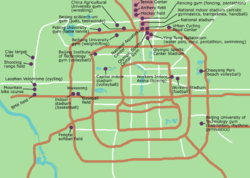
In Anticipation of a huge rush during the games, Beijing's subway system is currently undergoing a major expansion which will increase its capacity to more than twice its existing size. The system currently is composed of four lines and 64 stations. An additional seven lines and more than eighty new stations are being constructed, including a direct link to Beijing Capital International Airport. In the airport itself, eleven unmanned trains, each transporting a maximum of 83 passengers, will expedite the movement of people throughout the new terminal building.[17] Most of them are scheduled to operate from June 30, 2008, one month before the beginning of the games. In January 2007, the BOCOG announced that the Metro cars will be fitted with video screens showing the latest news and events during the games. Additionally, cellphone signals would be made available, so that people can use their communication devices in the metro stations or underground.[18]
According to the General Administration of Civil Aviation of China, a new five-level emergency alert system for extreme weather and security threats will be implemented in the airport. This system is designed to ensure smooth and safe transportation for the estimated three million domestic and overseas visitors who will flock to Beijing for the games in August 2008.[19]
On the ground, Beijing is set to designate thirty-eight official public transit routes that will link the Olympic venues. During the games, 2,500 large-size buses and 4,500 minibuses will be operated by a total of 8,000 drivers to transport people across various venues. Prior to the games, public transport will be optimized in order to reduce the existing 110 overlapping routes.[20]
Smoking is banned in the 66,000 cabs, the violation of which would lead to a fine of 100 to 200 yuan (13 to 26 USD). Beijing authorities are thus trying to make the event a non-smoking event.

The 2008 Summer Olympics emblem entitled "Dancing Beijing" (舞动的北京) was unveiled in August 2003 in a ceremony attended by 2,008 people at Qi'niandian (祈年殿) — the Hall of Prayer for Good Harvests in Beijing's Temple of Heaven (天壇 or 天坛). The emblem combines elements of traditional Chinese society—a red seal and a calligraphic word for jing (京) ("national capital") with athletic features. The open arms of the calligraphic word symbolizes the invitation of China to the world to share in its culture. IOC president Jacques Rogge was very happy with the emblem, saying, "Your new emblem immediately conveys the awesome beauty and power of China which are embodied in your heritage and your people."[21]

The Fuwa (Chinese: 福娃; pinyin: Fúwá; literally "good-luck dolls") were designed by Han Meilin. They were originally named "The Friendlies", but this name was dropped as Chinese officials were worried that it would be misunderstood as "friendless" or "friend lies."[22]
The Fuwa consist of five members that incorporate fish, giant panda, fire, Tibetan antelope, and swallow designs. They roughly correspond with the five elements of Chinese philosophy: water, metal, fire, wood, and earth. The Fuwa each have as their primary color one of the colors of the five Olympic Rings that stand for the five continents. The five Fuwa are named Beibei, Jingjing, Huanhuan, Yingying, and Nini. When the first syllable of each of the five names are said together, the result is the phrase 北京欢迎你 (Běijīng huānyíng nĭ) which means "Beijing welcomes you".[23]
The Beijing Olympic Organizing Committee began publicizing in early August 2006 that it will sell over 7 million tickets for various sporting events and ceremonies to the general public.[24] The chief of the committee expressed her hopes that all Chinese people would have a chance to come to the games. The committee has, therefore, set low ticket prices so as to encourage the Chinese people to become more involved in the Olympics.
On April 14, 2007, tickets to the general public went on sale through the Beijing Organizing Committee for domestic tickets (which will account for 75% of the sales) and through each nation's NOC for overseas ticket sales.[25] By June 2007, 2.2 million tickets—about a third of the supply volume—had already been sold.[26]

The slogan for the 2008 Olympics is "One World, One Dream" (simplified Chinese: 同一个世界 同一个梦想; traditional Chinese: 同一個世界 同一個夢想; pinyin: Tóng Yíge Shìjiè Tóng Yíge Mèngxiǎng.)[27] The slogan calls upon the whole world to join in the Olympic spirit and build a better future for humanity. It was chosen from over 210,000 entries submitted from around the world.[13]

Since early 2007, licensed Olympics merchandise stores have been in business throughout China. More than 800 official stores were in operation at the end of July 2007. Since August 2007, Olympic merchandise has been made available online, with more than 5000 products available via the official merchandising website, which include apparel, mascot dolls, key-chains and commemorative chopsticks.[28] In November 2007, overseas Olympic E-shop provide online access to customers all over the world to Licensed Products of Beijing 2008 Olympic Games. (Excluding the USA, Japan, UK, Canada and China)[29]
The official song for the game's one-year countdown celebration was entitled "We Are Ready"[30] with a version recorded by Hong Kong's Jackie Chan[31]. 106 contestants of Miss World 2007 performed the English version of the torch relay song "Light the Passion Share the Dream", composed by Chris Babida[32] About ten Olympic-themed music videos were recorded, including "Every One is Number One" by Hong Kong's Andy Lau[33], "Hero" by Chris Yu from Taiwan featuring the story of athlete John Stephen Akhwari from Tanzania[34], "Dream in Sight" by Zhou Bichang from China[35], "Forever Friends" by American Coco Lee and Sun Nan[36], "You, me, and him -- happily we participate" by Super Girl and Happy Boys[37], and "Together on the Blue Planet" by Nicholas Tse and Joey Yung from Hong Kong[38].
It was announced that Canada's Celine Dion[39] and Taiwan's Jay Chou[40] would perform during the opening ceremony.
"Beijing Huan Ying Ni," or "Beijing welcomes you" was the theme song for the 100-day countdown celebration, a follow-up to "We Are Ready".[41] During the celebration on 30 April, the song "Light the Passion, Share the Dream" was selected as the official theme for the torch relay. "I am a Star" and "Smile Beijing" were selected as theme songs for the Beijing Olympic Volunteers Committee.[42]


The program for the Beijing 2008 Games is quite similar to that of the Athens Games held in 2004. The 2008 Olympics will see the return of 28 sports, and will hold 302 events (165 men’s events, 127 women’s events, and 10 mixed events), one event more in total than in Athens.
Overall nine new events will be held, which include two from the new cycling discipline of BMX. Women will compete in the 3000 m steeplechase for the first time. In addition, marathon swimming events for men and women, over the distance of 10 kilometers, will be added to the swimming discipline. Team events (men and women) in table tennis will replace the doubles events. In fencing, women's team foil and women's team sabre will replace men's team foil and women's team epee.[b][43][44]
In mid-2006, video gamers held talks with the Chinese government in hopes of allowing video games to be a demonstration sport at the games. Demonstration events have not been held at any Olympic Games (Summer or Winter) since 1992.[45]
On August 7, 2006, a day before the 2-year countdown to the Beijing Games, the Beijing Organizing Committee released pictograms of the 35 Olympic disciplines. Each pictogram is designed so that people of nations around the world can recognize the different sports being played at the Olympic Games. This set of sport icons is named the beauty of seal characters, due to each pictogram's likeness to Chinese seal script.[46]
The following are the sports to be contested at the games. The Olympic sport of aquatics has been split into its constituent disciplines of diving, swimming, synchronized swimming, and water polo. The number of events to be contested in each sport is indicated in parentheses.
|
|
|
|
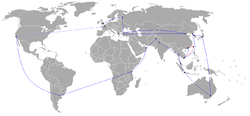
The plans accepted by the IOC for the Olympic torch relay were announced on 26 April 2007, in Beijing.[47] The relay, with the theme Journey of Harmony, is expected[48] to last 130 days and carry the torch 137,000 km (85,000 mi) — the longest distance of any Olympic torch relay. So far, the torch relay has been a public relations disaster[49] for China, with protests of China's human rights record, particularly in Tibet.
The relay began 24 March 2008, in Olympia, Greece. From there, it traveled across Greece to Panathinaiko Stadium in Athens, and then to Beijing, arriving on 31 March. From Beijing, the torch followed a route passing through every continent except Antarctica. The torch visited cities on the Silk Road, symbolizing ancient links between China and the rest of the world. A total of 21,880 torchbearers have been selected from around the world by various organizations and entities.[50]

The BOCOG carried the flame to the top of Mount Everest[50] on a 108 km (67 mi) long "highway" scaling the Tibetan side of the mountain especially built for the relay. The $19.7 million blacktop project spanned from Tingri County of Xigazê Prefecture to the Everest Base Camp. Environmental concerns about the effects of the road on the fragile Himalayan region were expressed by the media.[51] In March 2008, China banned mountaineers from climbing its side of Mount Everest and later persuaded the Nepalese government to close their side as well, officially citing environmental concerns.[52] It also reflected concerns by the communist government that Tibet activists may try to disrupt its plans to carry the Olympic torch up the world's tallest peak.[53]
The original route included a stop in Taipei before heading for Hong Kong. Taiwan's government, however, later rejected this proposal, claiming that such arrangement would make the Taiwan relay be seen as part of China's domestic route, rather than the international route.[54] The IOC eliminated Taipei from the relay; both China and Taiwan have blamed each other for injecting politics into the event.[55]

The Olympic Torch is based on traditional scrolls and uses a traditional Chinese design known as the "Propitious Clouds" (祥云). The torch is designed to remain lit in 65 kilometer per hour winds, and in rain of up to 50 millimeters per hour.
The relay has been a problematic, month-long world tour that has seen wide-scale protests to China's human rights abuses and recent crackdown in Tibet. After trouble in London saw several attempts to put out the flame, the following day, the flame was extinguished in Paris .[56] The American leg in San Francisco on 9 April was altered without prior warning to avoid such scenes, although there were still demonstrations along the original route, [57] but the remaining legs have not been as disastrous. The relay was further delayed and simplified after the devastating 2008 Sichuan earthquake affecting western China.
Though the qualifying competitions for various sports are well underway, it cannot be certain which of the current 205 National Olympic Committees (NOCs)[58] will participate in 2008. Most NOCs participate regularly, although various circumstances could cause a nation to be absent from the games, as was the case for six NOCs at the 2006 Winter Olympics. Nevertheless, placements in various qualifying events can help predict which nations and how many athletes will be at the games. Steven Roush, chief of sport performance for the United States Olympic Committee, expects that the United States will bring about 600 competitors to the games, their largest Olympic team thus far.[59] Other delegations will be much smaller; Afghanistan, for example, will be represented by just four competitors.[60]
South African swimmer Natalie du Toit, five time gold medallist at the Athens Paralympics in 2004, has qualified to compete at the Beijing Olympics, thus making history by becoming the first amputee ever to qualify for the Olympic Games.[61] [62]
|
|
|
|
The Marshall Islands and Tuvalu gained National Olympic Committee status in 2006 and 2007 respectively, and are expected to participate in the Games.[63][64][65] In May 2006 (just after the 2006 Winter Olympics), the citizens of Montenegro severed its political union with Serbia. The states of Serbia and Montenegro, which participated at the 2004 Games jointly as Serbia and Montenegro, will now compete separately. The Montenegrin Olympic Committee was accepted as a new National Olympic Committee in 2007.[65] On February 17, 2008, the IOC also promised to recognize the Republic of Kosovo as a new independent nation. However, it is not probable that athletes from the newly formed republic will be able to qualify for the Olympics in time to send a delegation to Beijing. Their participation is additionally compromised by the fact that the new nation has yet to be recognized by many other international athletic federations.[66]
North Korea and South Korea have considered sending a united team to the 2008 Olympics.[67][68] In the past, the two nations have walked together in the parade of nations during the opening ceremonies, but have never competed as one team. The two NOCs met with IOC president Jacques Rogge on September 5, 2006, to discuss the possibility of creating such a combined team.[69] In early 2007, Korean Olympic Committee President Kim Jung-Kil and North Korean Olympic Committee President Mun Jae-duk met to further discuss the logistics of sending a unified team.[68] At the meeting, South Korea advocated for the selection of athletes based on performance, while North Korea hoped for equal representation of athletes if the two indeed sent a joint team.[70] The NOCs failed to reach an agreement on representation, but said they would have further discussions in the future.[71]
These games will be the first to be produced and broadcast entirely in high definition television, and will likely garnerupwards of four billion viewers.[96] In their bid for the Olympic games in 2001, Beijing confirmed to the olympic evaluation commission "that there will be no restrictions on media reporting and movement of journalists up to and including the Olympic Games."[97]
In Canada the public network CBC/Radio-Canada and cable networks TSN and RDS will broadcast its final games before a private consortium involving CTV/Rogers/TQS takes over for the 2010 Winter Olympics, which will be happening within Canadian borders, in Vancouver.
Likely competitors in the Games, especially swimmers, have voiced dissatisfaction with the IOC's decision to schedule some events to meet the requests of NBC, which paid US$5.7 billion[98] for exclusive United States broadcasting rights to the Summer and Winter Games from 2000 through 2012.[99] NBC requested that popular events, such as swimming, athletics, basketball, and gymnastics, be broadcast live during television primetime in the United States between 8:00 and 11:00 p.m. EDT (between 00:00 and 03:00 UTC) for maximum advertising revenue. This would require events to be held in the early morning between 8:00 and 11:00 a.m., Beijing time. The IOC granted the request for swimming and gymnastics but denied it for athletics and basketball.[100]
Concerns over the games include the potential for boycotts from pro-Tibetan organizations such as Students for a Free Tibet as well as from organizations such as Amnesty International upset with China's involvement in the crisis in Darfur. China has also been battling problems with air pollution both in the city of Beijing and in neighboring areas, which the Beijing Organizing Committee (BOCOG) says it hopes to remedy before the games. The head of Interpol warned China on April 25, 2008 that there is a "real possibility" that the Beijing Olympics will be targeted by terrorist groups[101], as well as potentially violent disruption from pro-Tibet protestors.[102]


